
The Unexpected Classroom
Lehigh University Art Galleries' Centennial Reveals Art's Power Across the Curriculum
As Lehigh University Art Galleries (LUAG) marks its centennial anniversary, the museum celebrates a unique offering for the university — giving faculty members and students free and accessible ways to engage with art. And they have taken advantage of that opportunity in ways even LUAG’s director couldn't have dreamed up.
"I'm really proud to say that we have grown in working with every college across the whole university," says William Crow.
As the director of LUAG and the leader of the museum studies minor, Crow frequently relies on the galleries in his own classes. His Museum Collections and Exhibitions students, for example, spent the fall semester deeply engaging with the current exhibition, Here and Now: 100 Years of LUAG, 100 Local Artists. The students decided which pieces from the exhibition they would recommend the museum add to its permanent collection.
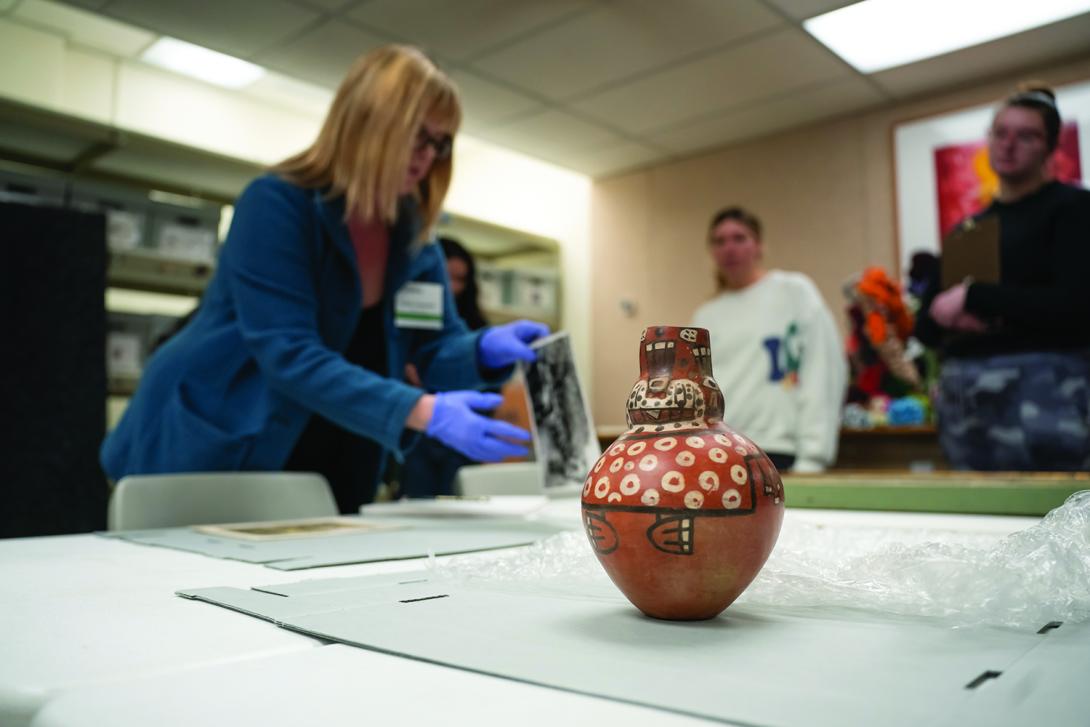
But Crow recalled the creative ways faculty outside the Art, Architecture, and Design Department have incorporated the galleries in their curriculum, as well. He described engineering faculty who brought students to study structural stresses on the outdoor sculptures, business faculty who brought students to learn how the skills they need to engage with art can also help them become more influential leaders, and education faculty exploring teaching with art.
Lawrence Tartaglia, a teaching associate professor and the associate chair in the Department of Biological Sciences, has brought his genetics class every fall semester since 2023 for an activity he calls the “Genetics Scavenger Hunt at LUAG.” His students are sophomores and juniors who are often stepping into the main gallery for the first time, he says. They start out skeptical of the exercise.
"As they start looking closer, something shifts. They begin making their own connections: DNA as a pattern, mutation as change, identity as inheritance. They view genetics through the lens of an artist and art through the lens of a geneticist. By the end, they’re not quite sure where one ends and the other begins — and honestly, neither am I," he says.
Art that Can Teach Anyone
The exhibitions that come through the galleries have been chosen with the potential for learning and engagement in mind, says Mark Wonsidler, curator of exhibitions and collections. Many of them come with the bonus of being useful in classes like Tartaglia's that make less obvious connections. With Curator of Education Stacie Brennan '03, Wonsidler thinks through the benefits of potential exhibitions.
"We're always having conversations about, 'What do we see as the potential for this kind of exhibition as opposed to another one? Can we engage a maximum number of audiences? Does it have a connection to a course or the particular scholarship of a professor or a group of professors—or a department on campus? Is there a way to tap into that obvious relevance we might know about?'" he says.
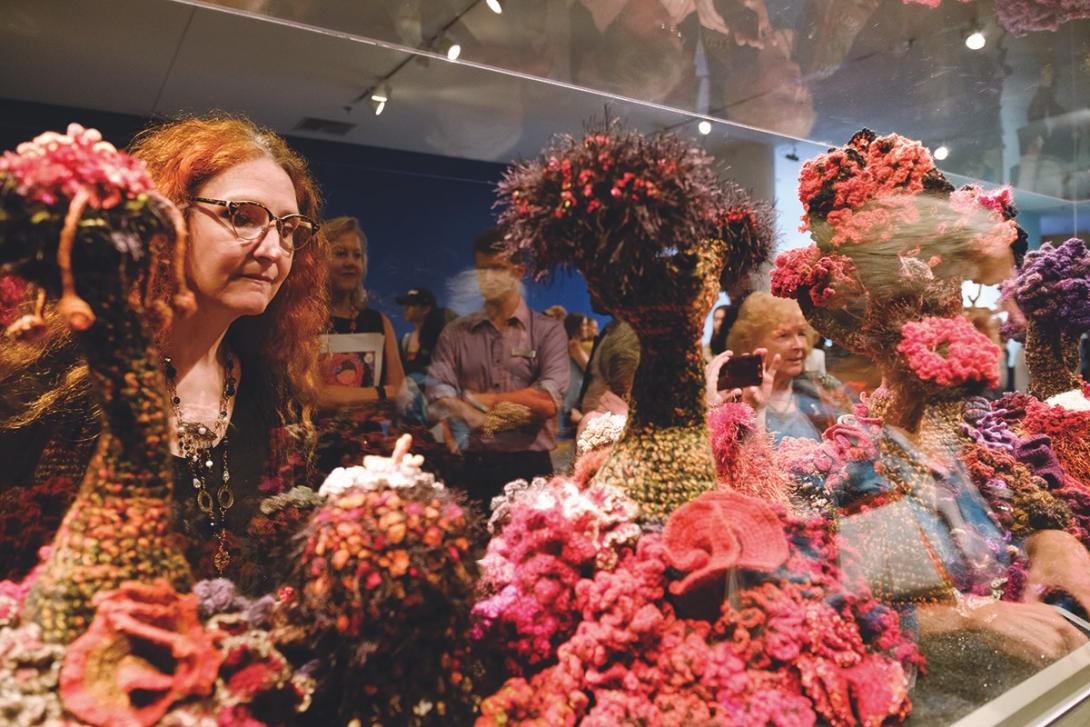
The Crochet Coral Reef installation, displayed at LUAG in fall 2019, exemplified art with relevance across multiple academic disciplines. Australian twin sisters Christine and Margaret Wertheim, founders of the Institute for Figuring, merged geometry and handcraft to explore environmental conservation themes, creating a resource that engaged several Lehigh departments. Visitors were invited to crochet hyperbolic coral reef structures using found and recycled materials.
In another example, Wonsidler collaborated with Annabella Pitkin, an associate professor who focuses on Buddhism in the Department of Religion, Culture, and Society, to bring the traveling exhibition Gateway to Himalayan Art from the Rubin Museum of Art in New York City to LUAG in 2023 for the first stop in its ongoing national tour. Pitkin says having the exhibit on campus gave students a chance to make connections between art and religion, culture, and society. Health students in her Intro to Buddhism course, for instance, could learn about traditional Tibetan medicine while examining paintings of the Medicine Buddha.
Even prior to that exhibition's arrival, Pitkin brought students to the galleries every semester for tours or to make art themselves.
"I often assign my students to spend time in the galleries, and then to choose two pieces, one Tibetan or Himalayan and one from another section of the galleries. Then they do a close visual analysis of the two pieces and think about how they 'speak' to each other," she says. "This provides a jumping-off point for many kinds of analytical and reflective writing projects, as well as often opening up perspectives and topics that students had not previously thought of. Family life, aging, migration, human relationships with the natural world, anxiety, and self-discovery are all themes students have come up with themselves and explored while doing these projects."
In his genetics class, Tartaglia's students explore 19 art pieces dispersed across campus — from LUAG's Main and Lower Galleries inside Zoellner Arts Center to network galleries in academic buildings. Students photograph the works and connect them to a provided list of questions, then explain why they chose each piece to answer specific questions.
"Being part of the College of Arts and Sciences, I love that this activity embodies both sides of that title," he says. "Art and science are often placed on polar opposite ends of a spectrum, but in the gallery, those lines blur into something more beautiful than either discipline on its own."
Art for Art Students
Of course, the most obvious classes to benefit from the galleries are those in the Department of Art, Architecture and Design. Collett Akins '27, who is majoring in art history and materials science and engineering, is interested in art conservation. She has worked at the galleries in various capacities since her freshman year at Lehigh, and in the fall of 2025, she was one of 16 students from across the university enrolled in Crow's Museum Collections and Exhibitions class.
The class was divided into three parts examining how museums collect works of art, then how they use those objects, and finally, how LUAG specifically chooses objects for its permanent collection. This particular group was tasked with recommending works from local artists in the Here and Now exhibition to add to the collection. Asked to look for works “that speak to the time they live in” Akins reflected on Al Johnson’s painting titled "Grandma's Chair," a piece she felt gives students a perspective on a story that could easily be forgotten.
"When I look at it, it makes me think a lot about this idea of ancestral knowledge and how a lot of times, especially women once they hit menopause, society doesn't value their opinion as much,” she says. But they still have so much knowledge. They still have so much to offer and give that could really benefit society and inform younger generations.”
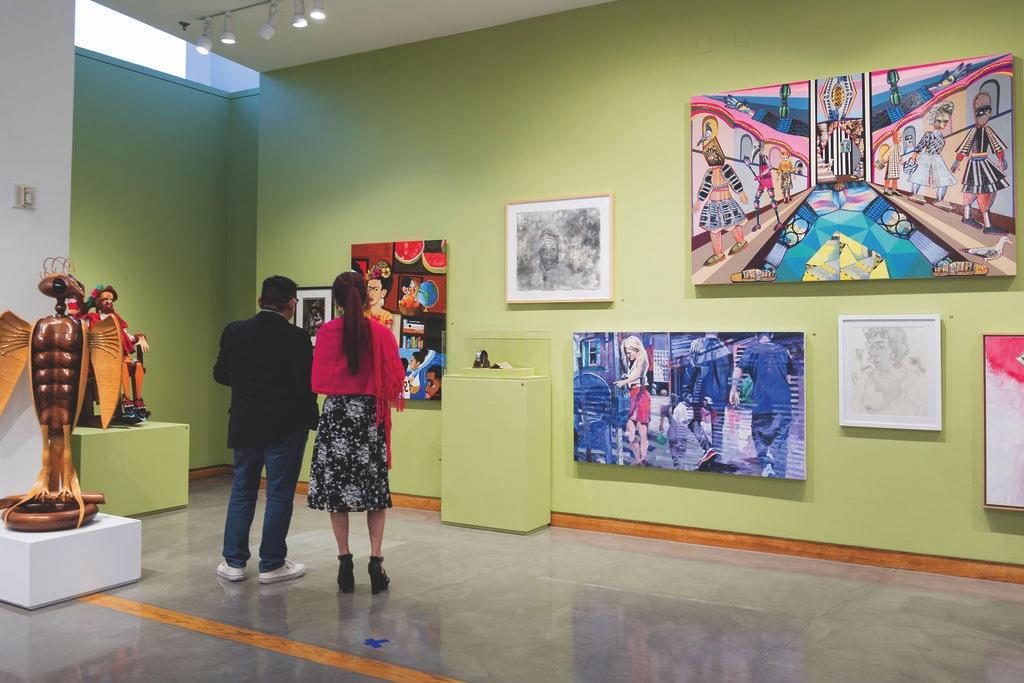
Crow teaches the class every other year. In 2021, the first time it was offered, the class was limited by pandemic restrictions and met via Zoom. The students considered works from local print houses — Durham Press, and Raven Fine Art Editions — LUAG added four of the selected works to its collection. In 2023, inspired by the recent LUAG-hosted exhibition Young, Gifted, and Black, students looked for works from living African American artists. The class traveled to New York City and met with the directors of a dozen art galleries, ultimately recommending that LUAG acquire a large relief sculpture by contemporary artist Lauren Halsey.
Crow says that when he was getting familiar with the art and artists who would be part of the current exhibition, he tried to predict which works the students would gravitate toward. It turns out he was "absolutely wrong," he admits with a laugh. Their perspective on technology and how art shows what it means to be human can be different from that of older generations.
"I'm really surprised that my students — even though they're interested in technology and they certainly use technology every day, including AI — are particularly excited about slowing down and unplugging and looking at a painting or a drawing or a work made by hand from clay or metal," he says. "They're really having a lot of great conversations about, ‘What is uniquely human about this and this perspective?’"
The graphic design students of Maurizio Masi, an assistant professor in the Department of Art, Architecture, and Design, got a unique opportunity in the spring of 2025 when LUAG leaders asked them to design the centennial exhibition's brand identity and its logo. They eventually went a step further and redesigned LUAG's primary logo, too.
The Fusion: Design Practice elective gives students the hands-on experience of producing work for a client, much like Masi did himself when he worked as a designer in New York for 25 years. In the spring, the class visited the Metropolitan Museum of Art in New York to learn from the leader of its internal design studio, and they listened to a pitch presentation from Lehigh's external design agency for its new brand campaign. Students reflected on those experiences as they researched and developed their own materials for LUAG. One of the biggest successes of the project was watching the students' develop strategy and presentation skills, according to Masi.
"Lehigh graphic design students presented and gained consensus on a logo redesign that literally encouraged LUAG to think outside the box for their new wordmark," he says. "LUAG had never requested to see their logo without its original enclosed box design, and in fact, it was somewhat discouraged. I am proud of our students for persevering and demonstrating that good, smart design prevails, having the power to change established perceptions."
Working in the Galleries
The deepest engagement any Lehigh student gets in the museum is as an intern or employee. In the fall of 2025, 22 students were working with LUAG, leading tours, organizing events, helping curate exhibitions, and welcoming visitors at the reception desk. Only a few of them are AAD majors.
Thomas Kaspereen '27 is pursuing a dual degree in neuroscience and philosophy, and he hopes to continue on to medical school to get an MD/PhD so he can do medical research. He loved art classes in high school and considered an art major in college, but he found a different way to incorporate art in his college experience. A New Jersey native, Kaspereen used his work-study benefits to start as a visitor services representative at the front desk at LUAG in his first month on campus.
Now Kaspereen continues to serve as a museum educator, helping to design programs for community members, leading tours of the exhibitions and outdoor sculptures around campus, and training fellow museum educators. In his senior year, he plans to pursue an independent project at LUAG. None of that is related to any of his classes.
"It's definitely a time commitment, but the work I'm doing is really enjoyable," he says. "I really look forward to having these kinds of experiences during my week when I have a lot of other stressful stuff to do."
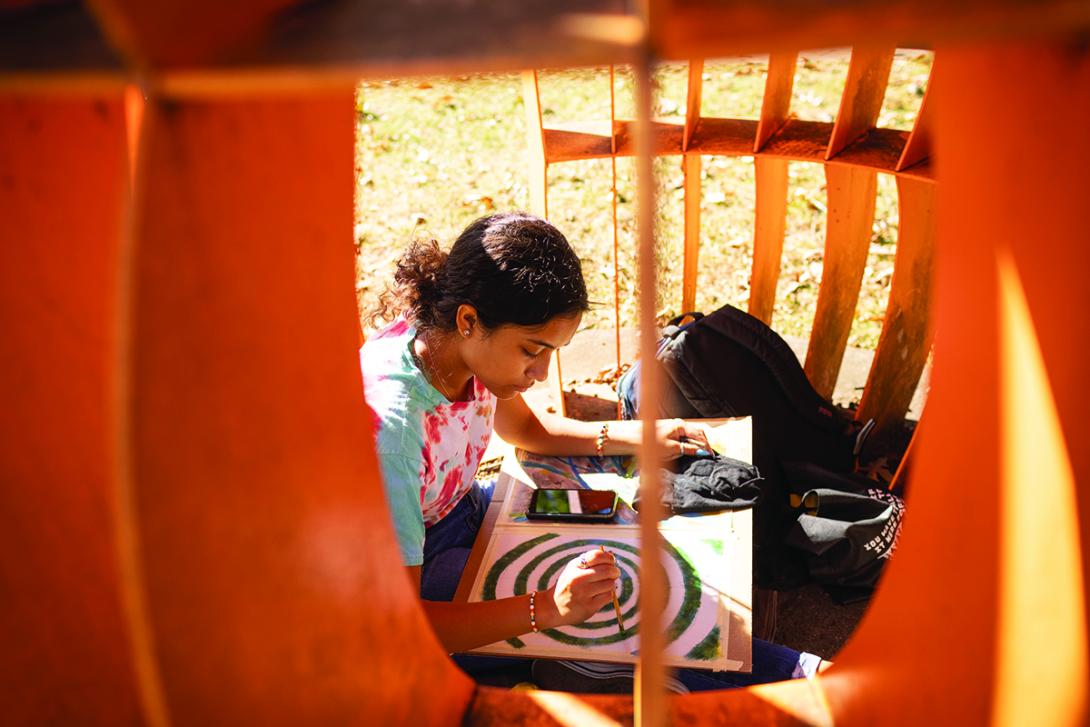
As an art history and materials science and engineering major, Akins came to the galleries from a different perspective. She chose to come to Lehigh from St. Paul, Minn., because she was interested in engineering and art. She took a museum studies class with Crow in her first semester on campus and joined LUAG's Peer Arts Council, the student-led club that contributes toward the galleries’ programming, exhibitions, and outreach. The next semester, she began interning at LUAG, conducting archival research and planning tours and events. In 2025, she assisted with an exhibition of Chinese ceramics from the collection that will be displayed in the lower gallery starting in the spring of 2026.
"My project specifically is looking at how changes in glaze technology in Chinese ceramics paralleled different periods of Chinese history and reflected different elements of Chinese culture," she says. "It's been really amazing because I now have the opportunity to combine that scientific knowledge with my art history knowledge."
For the exhibition, Akins is using all of the skills she learned in her art and engineering classes, as well as her work at LUAG. She researched which items in the collection might be a good fit, selected the ones to display, and created labels explaining their history and composition. She learned about the different materials artists used, and how they must be carefully maintained. And in doing so, she has become well prepared to go to graduate school and eventually work in a museum herself. What more could a teaching museum hope to accomplish?
"Bye for Now, Here and Now!" A Spring Sendoff Party
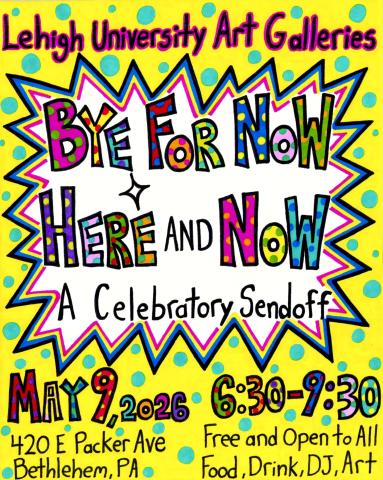
LUAG is planning a grand finale event for their centennial exhibition, Here and Now: 100 Years of LUAG, 100 Local Artists before it leaves the galleries. Join us for a celebratory sendoff on Saturday, May 9!
Learn More about the Event and RSVP